Defender Rescue 2 : How To Plunder - Pull The Pin Brain Teaser
Instructions:
Description
Defender Rescue 2 : How To Plunder - Pull The Pin Brain Teaser Strategy Guide
Pro-Level Advice
Slow down before you touch a single pin. That's the whole trick, honestly. Every stage looks like a mess of planks, ropes and spikes at first glance, but there's always a specific order hiding underneath the chaos, and yanking the nearest pin just because it's closest is how you get your knight skewered two seconds in. Scan the whole layout first, figure out which piece is holding up the rest of the contraption, and only then start pulling. Gravity does most of the heavy lifting once you find the right sequence, so let physics do the work instead of fighting it. Also, don't be afraid to fail a level a few times; watching how everything collapses wrong actually teaches you more than getting it right on the first try ever could.
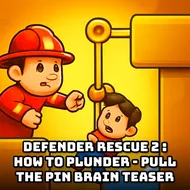
The setup is simple on paper: a knight needs to get past traps, enemies and rickety wooden structures to grab the treasure and pull the princess out safely. Each level is its own tiny puzzle box, packed with pins holding boards, cages, and hazards in tense balance, and one wrong pull sends the whole thing crashing down on your hero instead of the villains. It's the same bones as the original pull-the-pin formula, just stretched into trickier, more layered arrangements this time around.
Key Combinations
There's no combo list here, no button mashing, just your finger and a pin. Tapping and dragging pins out is the entire input scheme, which sounds almost too basic until a level throws four interlocking pins at you and suddenly timing matters just as much as order. Pull two at once in the wrong pairing and a spike wall drops early; hold off a beat too long and an enemy patrol wanders into position and ruins the run anyway. Some pins are decoys too, placed to look critical when they're really just there to bait a rushed tap. Treat each stage like a tiny riddle rather than a reflex test, and the rhythm starts clicking fast.